
As part of our webinar series, we ran AI for Organisations last week, a session for leadership teams ready to move past personal AI use and into company-wide operating model change.
From our work with several organisations, we find that many think adding AI tools and doing some training is enough to realise the real benefits of AI. Tools and training are not the wrong starting point, but that is where most rollouts stop. The pilots succeed, people get faster on specific tasks, and then nothing scales.
The ceiling of training only
When you train people on AI, they get faster on the work they personally control. Drafts, summaries, research, code, analysis: 2-10x improvements on specific tasks are normal.
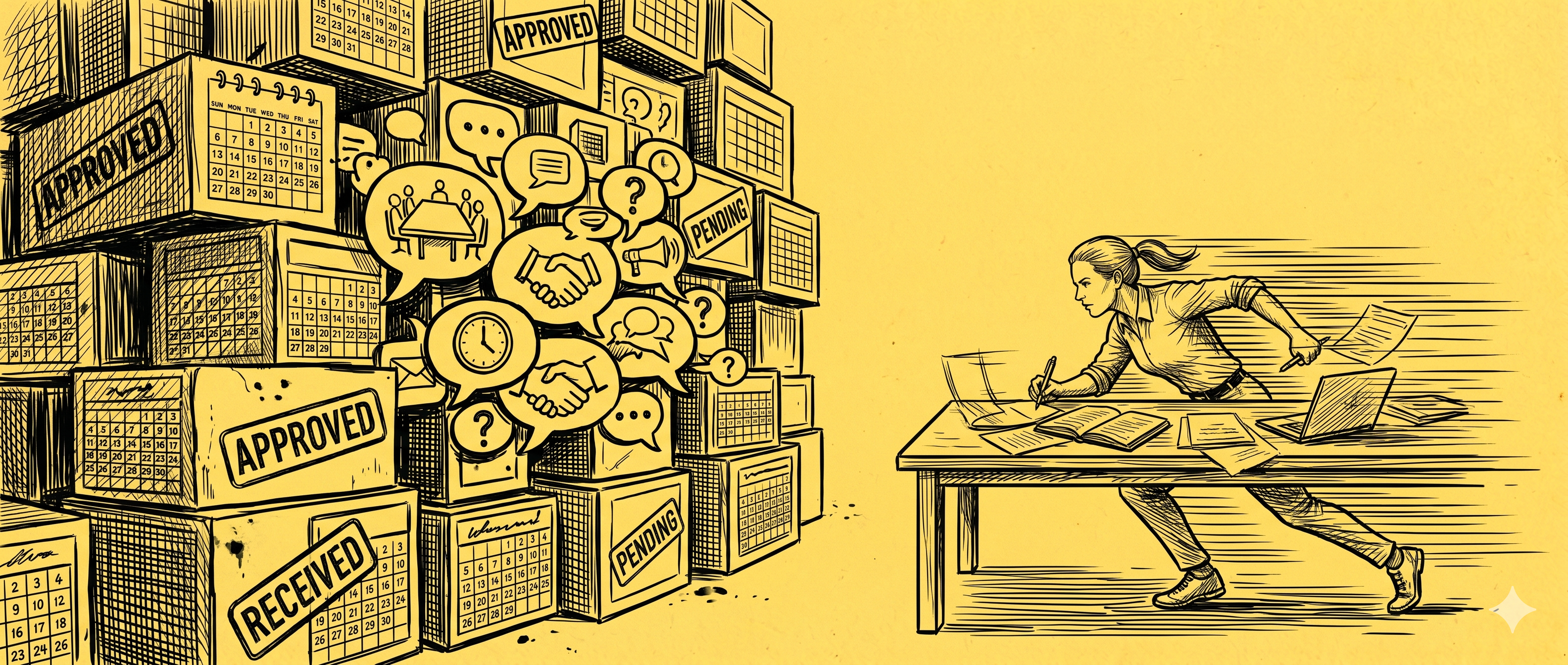
Then the work hits a handoff: a meeting, an approval loop, a manual status update. Old coordination overhead absorbs the gain before it reaches the system. The individual is faster but the organisation is not.
Speed is invisible at the system level until you redesign the system. Local wins accumulate, but the system stays slow. Work still waits for meetings, managers still coordinate things that could be self-running, and data still lives outside the workflows where agents need it.
The new operating model
Most leadership teams we work with have already moved their people onto AI tools. That is progress with measurable productivity gains, but it is still a human-led process. Humans do the work at every stage: ideation, execution, QA, release. AI assists along the way but the process itself has not changed.
What has also not changed are the coordination gates between those stages: the discussion and approval meetings, the review cycles, the final sign-offs before anything moves. Those gates exist because humans need to synchronise state with each other. They are a consequence of a process designed around human handoffs.
Most organisations sit at this point right now: teams use AI daily and feel faster on individual tasks, but the operating model (the sequence of who does what, who approves what, and what triggers the next step) still runs on the same logic it always did.
The AI-led process is designed differently.
AI executes each stage: ideation, execution, QA, release. Between stages, there are lightweight human review gates, not coordination meetings. The human’s job is to validate and govern, not to do the work and coordinate its movement. Total time collapses, not just because AI is faster at each task, but because the coordination overhead between tasks disappears.
Replacing the coordination logic is what changes the team size. A team that previously needed five people for a workflow (one per stage, one to own the handoffs) can now run the same objective with one person governing an agent system. The other four are free to own new outcomes entirely.
The real lever is redesigning each objective around AI by default, not layering AI tools on top of a process built for humans. Start from the outcome and work backwards: what does the agent execute, where does the human validate, and what state does both need to work from.
That is the operating-model decision.
What an AI-default workflow requires
Here is what this looks like from inside Whitesmith.
Our sales qualification used to wait on whoever picked up the inbound first. Now an agent watches Gmail, Pipedrive, and Granola on a 15-minute routine. The objective is to catch every qualified lead inside 24 hours. The autonomy contract lets it score, classify, draft replies, and schedule re-touches. It cannot send mail, move a pipeline stage, or quote a rate. Pipedrive is the source of truth, with a structured agent note on every deal. A human reviews and decides.
Same objective, smaller team, faster response, full audit trail.
Five ingredients made that possible and show up in every AI-default workflow we have shipped:
- Objective: What outcome should change? Which OKR, KPI, or customer result is on the line? Skip this and you are automating busywork
- Autonomy contract: What the system can decide, draft, update, escalate, or stop, and what it cannot? This needs to be written down, not assumed.
- Source of truth: Where decisions, state, evidence, and context live. The agent reads and writes here, with no parallel pipeline running alongside it.
- Workflow routine: What runs on a schedule, on a trigger, or when a human asks? Routines compound in a way that ad hoc prompts cannot.
- Review and accountability: Who owns the result, validates exceptions, and changes the system when it stops being right? AI executes more. Responsibility still lands with a person.
Put these five in place around one objective and you have a redesigned process. Skip any of them and you have a clever demo.
The structural shift
When you do this across a few objectives, the organisation chart starts to change, and the changes run deeper than headcount.
Each objective needs fewer people to run. Sometimes one person plus an agent is enough for work that previously required a team. Vertical management layers thin out because there is less coordination overhead between them. Individuals gain the full vertical of what they need to deliver, rather than owning one step in a chain that twelve other people also touch. And the freed-up capacity makes ambitions possible that you could not previously fund.
The mindset shift underneath this is the hard part. The question changes from “how do I do the same with less?” to “how much more can the same team own?”
The structural changes extend further than organisation design. Organisational memory has to become the substrate from which agents can actually work. Decisions, project scopes, CRM state, meeting notes, internal documentation, support tickets: all of it needs to be structured enough that an agent can read it, reason about it, and write back to it reliably. Most organisations have this information, but it is spread across tools and people’s heads in ways that only humans can currently navigate. Making it machine-readable is infrastructure work, not AI work, but without it every agent runs blind.
The management role changes too. A manager running an AI-enabled team is no longer primarily a capacity coordinator, they are a designer of autonomy contracts. For every system they put in place, five questions need explicit answers: what outcome it optimises, what it can change without asking, what state it reads and updates, when a human validates or overrules, and who is accountable for the output. Getting those answers written down before the system runs is the new management discipline. Adding agents without answering them is how you end up with systems that work in demos but fail in production.
A path you can execute
There is no value in a plan that starts with discovery and ends with a deck. The only plan that produces evidence ships something real.
- In the first 30 days: select two or three workflows, define the source of truth for each, write the autonomy contract, and train the owners on review. Pick workflows where judgment is high enough to need a person, but repetition is high enough for a routine to compound.
- In the second 30 days: run the AI-first version in parallel with the old one. Define success criteria up front: speed, quality, error rate, and cost. Do not retire the old version until the evidence supports it, not when it feels ready.
- In the final 30 days: scale by objective, not by tool. Re-evaluate the relevant OKRs with human-plus-agent ownership in mind, assign owners, set governance. Build a demo library so the people who ran the pilots can transfer the operating grammar to the next team.
Before committing to a workflow, work through this on each candidate: which work disappears when the agent owns the routine, which decisions can move to the system, what makes the autonomy contract explicit enough to be safe, what state must exist in the source of truth, and where does a human stay accountable for the output. The workflow that lets you answer all five is the right first choice.
That loop, run three or four times, is what a serious 90-day plan looks like. It also builds the internal capability that matters most: people who know how to scope autonomy contracts, structure briefs, and run review loops.
AI momentum check
Before building your 90-day plan, it helps to know where you actually stand. The diagnostic we run with leadership teams at the start of every Whitesmith engagement is available as a free online tool.
The AI Momentum Check takes about eight minutes. It scores your organisation across six dimensions of AI momentum and places you on a spectrum from “Standing still” to “Setting the pace”. At the end, you get the two or three moves that would shift the most in the next 90 days. The same framework, the same questions, the same read we give to clients in week one.
If you are not sure where to start, start there.


Webinar: October 28
AI workflows for project managers
AI workflows for project managers
Free webinar - October 28
