At Whitesmith, a handful of agents already run inside our own operations, not just experiments. A weekly management review pulls financial, pipeline and utilisation data with zero manual compilation. Pulling the numbers and building the slides for our company meetings used to take four hours. Now it takes one hour. Each one moved a piece of work that used to sit with a person onto a system that prepares it and waits for a decision. That shift, from a person moving the work to a person reviewing it, is where the real improvement in how a business operates comes from.
In July we detailed one more of these agents, the one that runs our month-end invoicing close, at a webinar for operations leaders on what changes when an agent runs part of a workflow instead of a person. This is the short version of what we showed.
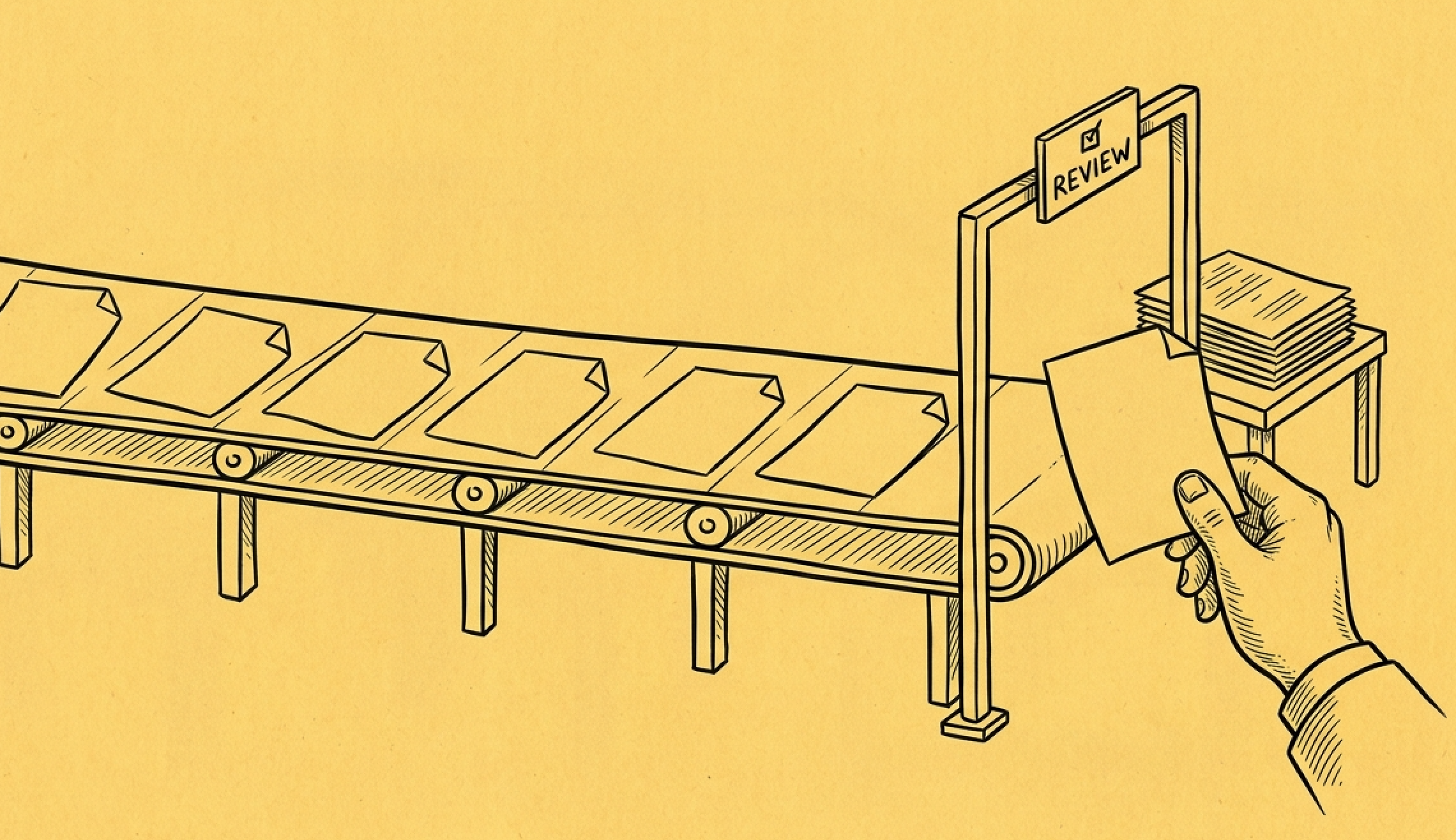
That agent runs the close every month now, on its own. It pulls what is billable across four systems, reconciles every line against its source, drafts the invoices, flags the ones it is not sure about, and logs its reasoning for each call. Then it stops and waits for me. I open one review sheet, check the flags, approve the rest, and sign off. For years that close was mine to do by hand: about a day of it, every month.
From assistant to operator
Most teams already use AI to move faster. You write a prompt, you get a draft, and you still do the next step yourself. What’s changed over the last years is who does the work between review points. An agent can prepare, reconcile, and flag on its own schedule, so the manual handoffs between steps disappear, and a person’s job compresses into the parts only a person should do: reviewing, deciding, and steering.
One question sorts a human-led process from an agent-led one. Who moves the work between steps today? If the answer is a person with browser tabs open, the process is still human-led, no matter what tools sit inside it.
What made the invoicing agent work
We spent more time deciding what the agent was forbidden to do than building it, and we wrote that autonomy contract before we wrote anything else. It can pull billables, draft invoices, reconcile against every source, and flag what does not add up. It cannot issue or send an invoice, and anything above a set amount waits for a person.
The reconciliation that used to take a day now takes no more than 30 minutes, and I spend that time on the handful of lines the agent flags instead of every line.
The awkward part of our close was always the intragroup line that never quite reconciled on the first pass. That is where an agent earns its place. It reasons through the mismatch and shows its working, instead of following a rigid rule that would have passed the bad line straight through.
It defaults to a hold when it is not confident or an amount is over the cap, and it stops to ask. Every call it makes is written to a log with its reasoning, so a person can audit it later in one place. Before it ran on its own, it ran in shadow mode, making its calls alongside me until what it flagged matched what I would have flagged too. The one time it was wrong, it had reasoned soundly on a stale input, and the review gate caught it before anything went out.
The blueprint underneath
Both of the workflows we showed, invoicing and inbound sales, sit on the same seven decisions: the objective, the owner, the source of truth, the trigger, the autonomy contract, the review gate, and the metrics. Each one is a choice someone has to own before the agent runs.
Two of them get skipped most often: without an owner, no one is accountable when the agent flags something, and without metrics, you cannot prove the workflow improved anything, so it dies in the next budget conversation. The blueprint is tool-agnostic. Whatever platform you use, these seven decisions are the actual work.
What changes for you
The workflow is the easy part to explain. The bigger change is to your own job, and it is not just adding an agent to the process you already had. Owning a process stops being about moving it through the manual steps yourself. It means redesigning the process with AI as a primitive: deciding what a person owns, what an agent prepares, and where the two meet at a review gate, instead of bolting an agent onto a step that was built for a person to do by hand. That is what changed in our own invoicing close. The autonomy contract, the review gate, and the shadow-mode testing all came before the workflow did.
Four jobs come with that: designing the workflow, setting the autonomy limits, guarding the review gates, and improving the system from the exceptions and the misses. The review gates are the ones to guard. Under deadline pressure, teams drop them first, and they keep gains durable instead of the workflow breaking the first time something changes.
Where to start
Pick one workflow that is repeated, owned by one person, measurable, and backed by a source of truth you already trust. Avoid anything irreversible, anything without a clear owner, and anything where the data lives in five inconsistent places. Data quality is the one that bites. Both of our agents work because their sources already existed.
This week, take that one workflow and let an agent prepare the first draft while you review it. The goal is a real working process you sign off each month, not a demo that impresses once.
The review gate answers the obvious worry: agents make mistakes, but nothing ships without a person signing it off, so a mistake cannot reach a client. The harder-to-see cost is the time your team still spends doing work by hand instead of reviewing it.
We walked through both workflows, the seven-decision blueprint, and the governance in full on the webinar. The recording is on our webinars page.
If you want to run the blueprint against your own close, or any other process, we can do that in a 90-minute diagnostic.


Webinar recordings
Watch our webinar recordings
Watch our webinar recordings
Free webinar recordings
