
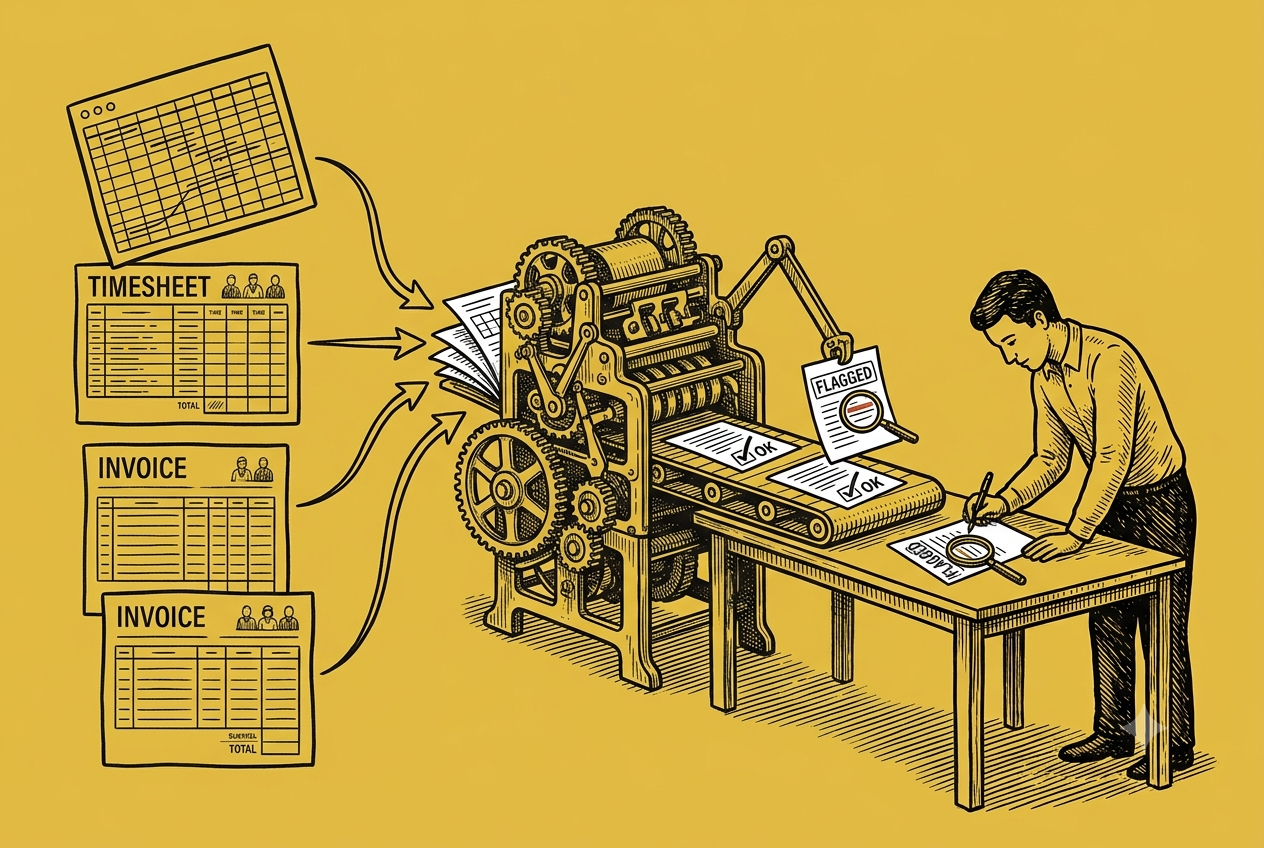
The real leverage in AI isn’t a tool that helps one person work faster. It’s an agent that runs an entire business process on its own, with a person stepping in only where judgment actually matters. Our monthly invoicing is the clearest example we have of that shift, and it’s worth walking through because every company has a process like it.
It used to be human-led. Every month, someone pulled the billables, matched them to the work that actually happened, confirmed the right entity, chased the intragroup line that never quite reconciled, then checked the whole thing again before it went out. None of it was hard on its own. There was just a lot of it, spread across four tools, and it all lived with one person.
The first iteration: a faster, still human-led process
The first thing we did was the obvious thing. We wrote a few scripts to pull the data and generate the invoices, instead of building each one by hand. That change on its own gave us back real time, and it was the biggest single jump we’ve had in this process.
But it only solved half of it. The invoices came out fast, and then we still had to sit and validate them: cross-check the billables against the time data, confirm the entity, reconcile the intragroup line, make sure the month matched. Generating was automated but all the steps before and after were not. So the work moved from “assemble everything by hand” to “verify, click generate, then verify again by hand.” Better, but still one person clicking between four tabs at month-end.
This is the stage most teams reach and mistake for the finish line. It was faster, but still human-led: the scripts assisted, and a person did the actual work at every step, carrying the state between tools in their head.
The second iteration: an AI-led process
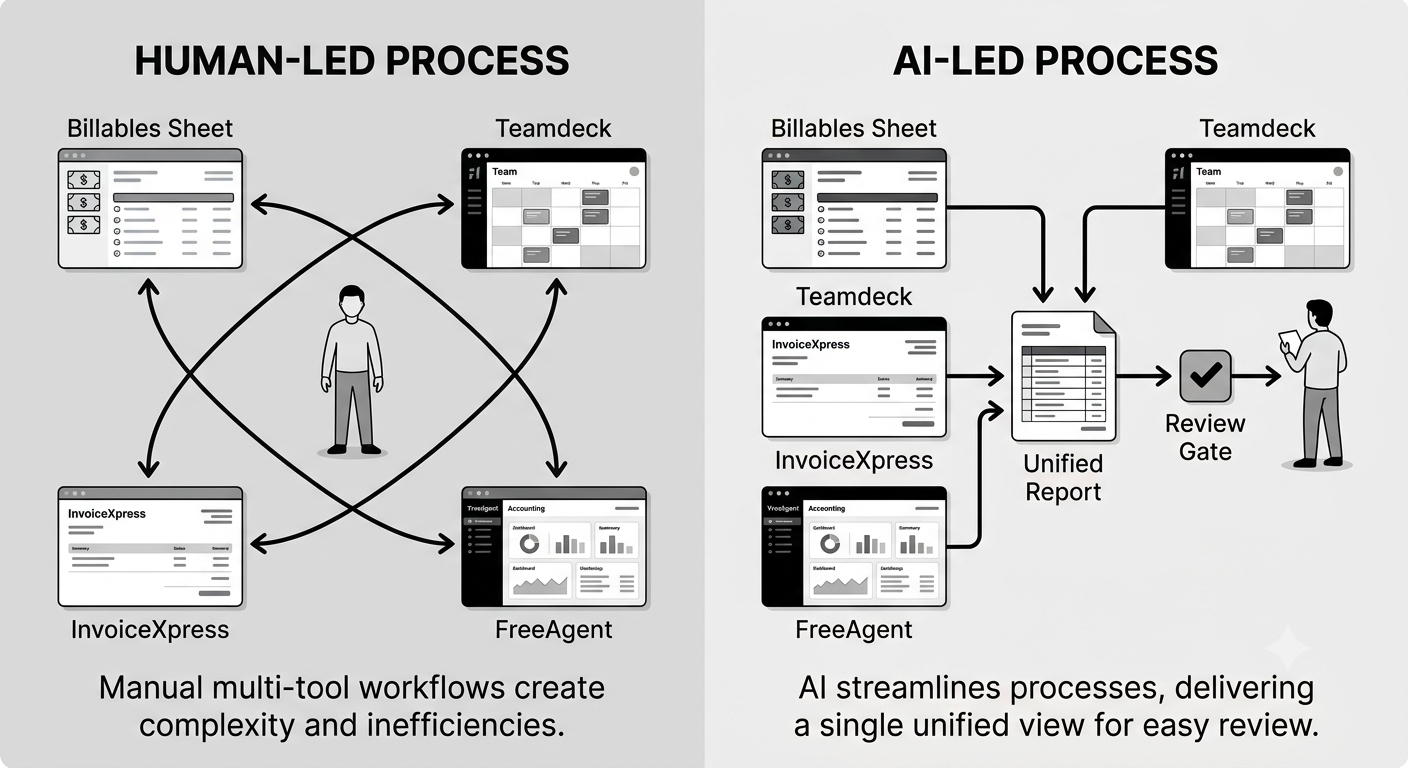
The version running today takes on the checking itself. Think of the month-end run as a short pipeline: pull the data, generate the invoices, reconcile them with every source, flag anything that doesn’t add up, and stage everything for sign-off. In the human-led version, a person did every step except the generating. Now the flow runs the pull, the reconciliation, and the flagging. It compares multiple relevant sources and stops at a single review gate. A person opens it, reads what the flow found, and approves or corrects. The work sits with the system, the judgment and the sign-off sit with the person.
This is the shift we described in the AI for Organisations webinar session. In a human-led process, people do the work at every stage, and AI assists. An AI-led process flips it: the flow does the work, and the person moves to a review gate to validate and govern rather than to do and coordinate.
This step wasn’t about time, as we banked that in the first iteration; now it was about context switching. Confirming a run used to mean moving between three or four tools and holding the picture together in our head. Now it lands in one place: we open a single sheet, read the logs, and confirm. The flow no longer depends on one person being around and remembering how the pieces fit.
What makes this agentic rather than just automated sits in two places. First, in how it was built: non-technical people put it together themselves by describing, in plain language, the checks they already run, not by writing code. Second, in how it runs: the agent interprets those checks and reasons through the messy cases instead of just following a rigid rule; it looks to the different tools, works out why they differ, and tells the person what it thinks happened.
The flow is built to hold rather than guess: anything the agent isn’t confident about, or above a set amount, waits for a person, and every call it makes is logged with its reasoning. On top of that, the agent first ran in shadow mode, making its calls alongside me, and it matched them on nine out of ten items. The one miss is the instructive part: the reasoning was sound, but it read a figure from an old location, so a correct analysis rested on stale input. The review gate caught it, the log showed exactly which number it had used and where it came from, and the fix was pointing the flow at the right source, not rebuilding anything.
That’s the pattern to expect from agents in operations: the judgment usually holds; it’s the context you feed them that needs to be governed.
What an AI-led process means for leaders
This is a good example of AI in operations precisely because it’s so ordinary. Every company has some version of it, and most people only notice it when it breaks. It’s also where AI pays off, as long as the process underneath is clear. If it’s well understood, the system can do real work. If it’s vague, you just accelerate the confusion.
This is a contained example on purpose. It’s one workflow, and just one of the several finance tasks we have to do each month. The payoff of an AI-led process compounds when you apply the same move across those other tasks, and across workflows that run through several people, because then the handoffs and sign-offs between them collapse too.
The shift worth planning for is moving from personal AI use, where a tool helps one person go faster, to workflows the process itself carries, built and owned by the people who run the work rather than handed to a separate engineering team. The place to start is usually where people reconcile the same facts across several systems. That is where the leverage is, and it’s rarely in replacing the judgment at the end.
That is exactly what we’re getting into in our next webinar on july 15th: how to spot the workflows worth rebuilding, how to structure one so an agent can carry it, how to give it the context it needs, and how to keep people where judgment still matters. If your team is past the question of whether AI is useful, and into the harder one of where it should actually run, this session is for you.
AI for Leaders: How to run business operations with agents
Wednesday, July 15, 2026, 4pm west
Register here: https://whitesmith.co/webinar-leaders/And if you can’t make it live, register anyway. We’ll send the recording.


Webinar: October 28
AI workflows for project managers
AI workflows for project managers
Free webinar - October 28
