
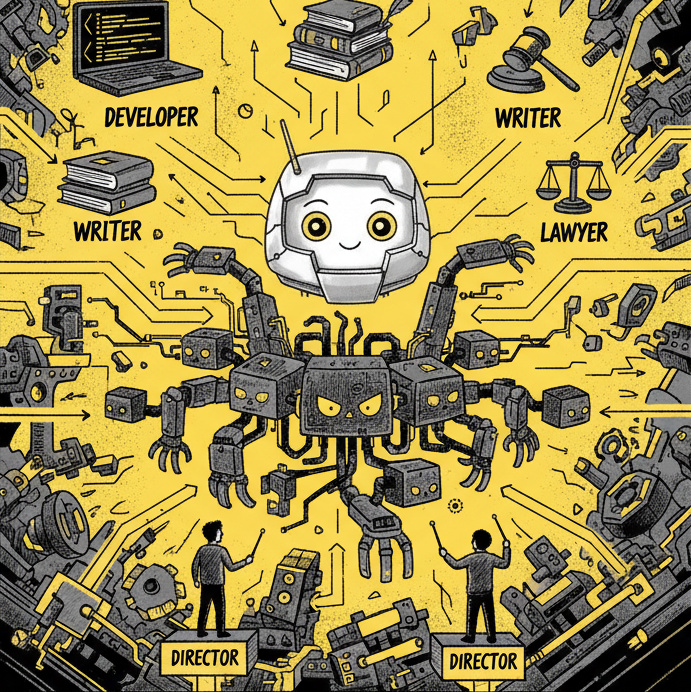
If we define AGI not as a conscious being, but as a system that possesses more knowledge and skill than the average human across a wide variety of professional domains, then the conclusion is clear. We are already there.
For a business, it’s irrelevant whether AGI is a single monolithic model or an orchestrated collection of specialised AIs, what matters is the result. Today, we have multiple systems and models that can, and already do, outperform the average developer, the average writer, the average lawyer, and so on, in their core tasks.
This is the essence of practical AGI. It’s not one superhuman employee; it’s an assembly of AI tools that, when working in concert, create a capability far greater than the sum of its parts. We don’t have one AI that does it all, but we don’t need one. We have a team.
We can think of it this way: a company isn’t just one superhuman employee. It’s a team of specialists, from finance, marketing, engineering, etc, working together. Practical AGI is the same. It’s an AI-powered team we can build right now.
The practical impact: standardisation and automation
For a long time, the most powerful AI models were black boxes, the exclusive property of a few tech giants with proprietary models. That is no longer the case.
Since “Deepseek R1” and now with the latest “Kimi K2 Thinking” model from Moonshot AI we have an open-source core recipe for building world-class AI: training pipelines, advanced architectures like Mixture-of-Experts (MoE), finetuning, alignment and reasoning methodologies, allowing these models to achieve performance on par with the best closed-source systems like GPT-5, Grok 4, and Claude 4.5 Sonnet.
This democratisation means the power to build and leverage elite AI is no longer a secret. The competitive advantage is shifting from having the model to integrating it effectively.
The immediate consequence of practical AGI is transformative for business operations. Companies can now codify their best practices and institutional knowledge into automated, AI-driven processes. This allows for unprecedented levels of standardisation and efficiency.
Imagine an engineering workflow where an AI architect plans an entire epic with full codebase context, specialist AI coders implement the changes, and an AI reviewer provides quality assurance. This “system of systems” approach, which you can read more about in the post “Don’t fire your AI coder, give it a product manager”, ensures that every task is executed quickly, consistently, and with a high degree of quality, freeing human talent for more strategic work.
The first roles to be impacted will be those centred on repeatable, well-defined tasks. These low-hanging fruit jobs will increasingly be performed by AI, not as a replacement for the human workforce, but as a fundamental upgrade to a company’s operational capacity.
The future of work: humans as directors, not doers
This shift promotes people instead of making them obsolete. While humans will still be needed to guide and program the AIs (for now), their core function is evolving.
The future of work will see humans gradually taking on more high-level planning, strategy definition, and review of AI-generated output, while spending less time on low-level implementation and repetitive tasks. The workforce will transition from being doers to being directors, orchestrating AI systems to achieve strategic goals. This is a more engaging, creative and ultimately more valuable role.
It is crucial to distinguish this from General Super Intelligence: a hypothetical AI more intelligent than the brightest humans in all fields. We have not reached that point. But we have a growing arsenal of models that already rival the best humans in many specific, high-value tasks.
The question for leaders is no longer “When will AGI arrive?”. The real question is: “Now that practical AGI is here, what are we going to build with it?”.
Navigating this shift to AI-enabled processes requires both strategic vision and technical expertise. It asks for a new way of thinking about teams, technology, and value creation. At Whitesmith, our fractional CTO service is designed to help leaders build these powerful systems, automate core processes and chart a clear, pragmatic course for an AI-driven future.


Webinar: March 18
Claude for Leaders: turning AI into strategic advantage
Claude for Leaders: turning AI into strategic advantage
Free webinar - March 18
