
Your engineers are already using AI. Some are prompting ChatGPT for boilerplate code, while others have Copilot suggesting lines, and a few are experimenting with advanced tools like Claude or Cursor. Individually, they’re finding pockets of productivity.
However, as a leader, you’re asking the right question: Is any of this creating a sustainable and competitive advantage for the business?
At Whitesmith, we saw the same story playing out with our partners and our own teams: isolated experiments delivering inconsistent results. The breakthrough came when we stopped treating a revolutionary technology like a personal productivity hack and started building it as a core engineering capability.
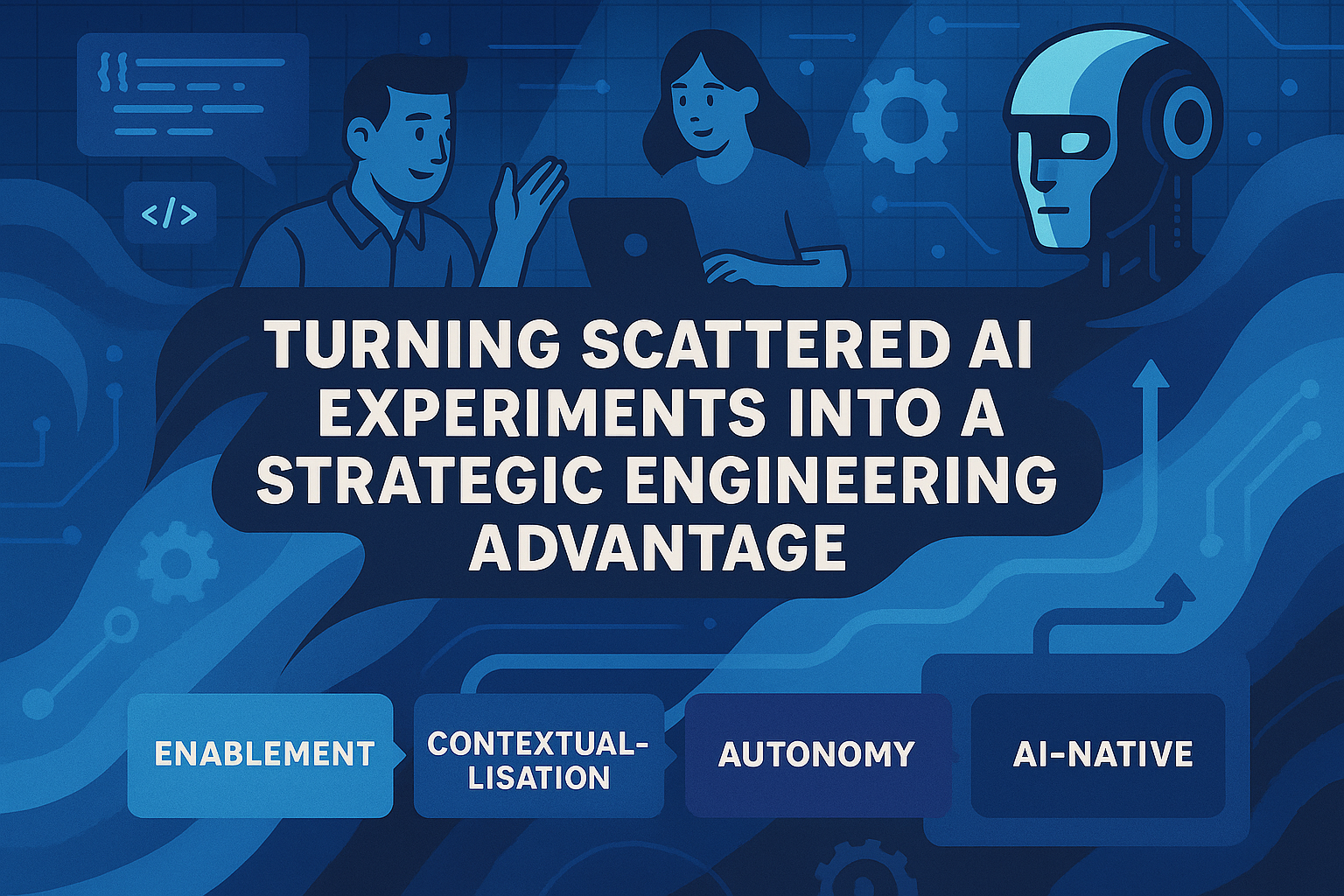
We developed a four-phase maturity model to guide this transition. It’s a roadmap from ad-hoc usage to systematic excellence, designed to deliver measurable, compounding returns.
The payoff: from ad-hoc gains to systemic advantage
Before we break down the framework, let’s talk about impact. This isn’t theoretical. By implementing this model, we transformed key workflows:
- Drastic efficiency gains: We streamlined QA documentation for complex features, reducing a 4-hour manual process to a 30-minute review. An 87% reduction that frees up our team for higher-value work.
- Unbreakable consistency: AI-driven processes now generate PR descriptions, release notes, and documentation that adhere to our highest standards, every single time. This eliminated quality drift and standardised our output across the entire team.
- Accelerated onboarding: New engineers can produce professional-grade documentation and code contributions from day one, because our best practices are now embedded directly into their AI-powered tools.
This is the difference between an engineer using an AI tool and a team leveraging an AI system.
The Four-phase AI maturity model
Phase 1 - Enablement: building a culture of experimentation
Most organisations start and stop here. They grant access to a tool, maybe run a webinar, and expect transformation to happen organically. It rarely does. True adoption requires creating a structured environment for curiosity.
Instead of just “permission,” we focused on building a culture of guided experimentation:
- Monthly hackathons: 2-hour build sessions where teams experiment with AI solutions and demo outcomes
- Weekly catch-up: Dedicated meetings to discuss AI developments and share discoveries
- AI Weekly Digest: Curated updates on the latest tools and integrations discussed during team calls
- Proof of concept first: Individual success stories before pushing team-wide adoption
The goal of this phase is to move from sporadic, individual use to a team-wide culture of purposeful AI experimentation.
Phase 2 - Contextualisation: making AI speak your language
Generic tools produce generic results. The real productivity leap happens when AI understands the nuances of your specific codebase, architecture, and domain.
In this phase, we teach the AI to work like a seasoned member of our team. For one of our clients, this meant:
- Custom prompts: Workflow-specific prompts for QA documentation, PR creation, and release notes that understand our domain
- CLAUDE.md files: Mobile team invested in comprehensive context files encoding architecture patterns, conventions, and coding standards
- Slash commands: Purpose-built commands for everyday development tasks integrated directly into Claude Code
The goal of this phase is to transform a general-purpose AI into a specialist assistant that understands your projects, standards, and goals.
Phase 3 - Autonomy: entrusting AI with complex workflows
This is the stage that many teams attempt to skip prematurely, resulting in unreliable results and frustration. Autonomy is more than a starting point; it’s a capability earned through the foundational work in Phases 1 and 2.
With a contextualised AI, you can begin automating multi-step processes. Our current frontier is building multi-agent systems for mobile development. These agents write code, analyse code changes, review visual assets (like screenshots from a PR), and cross-reference business requirements to generate comprehensive test plans. This level of automation is impossible without the deep context established in Phase 2.
The goal of this phase is to evolve from AI-assisted tasks to AI-driven workflows that operate with trusted autonomy.
Phase 4 - AI-native: designing workflows for AI
This is our North Star. It represents a fundamental shift from retrofitting AI into existing human-centric processes to designing new workflows that leverage AI’s unique strengths from the ground up.
Imagine repositories structured not only for human readability, but also for optimal comprehension by an AI agent. Imagine feature development where an AI can be tasked with an entire user story, executing scoped changes across the codebase with the right level of human oversight.
This is about building a system where human creativity is amplified by intelligent, autonomous execution. The systematic foundation built in the earlier phases is what makes this future possible.
The journey from tool to capability
The promise of AI in engineering is immense, but it won’t be realised through casual adoption. A lasting advantage comes from a deliberate and systematic approach. By moving through the phases of Enablement, Contextualisation, Autonomy, and AI-Native design, you can transform a collection of clever tools into a powerful, strategic capability that drives your entire organisation forward.
Where is your team on this journey?


Webinar: March 18
Claude for Leaders: turning AI into strategic advantage
Claude for Leaders: turning AI into strategic advantage
Free webinar - March 18
