A foundational principle of the open internet has always been the presence of signals or cues that allow us to assess the quality, effort and legitimacy of a digital creation. A well-maintained GitHub repository, a meticulously designed website, a detailed technical blog; these were never perfect measures, but they worked as proxies for care and credibility.
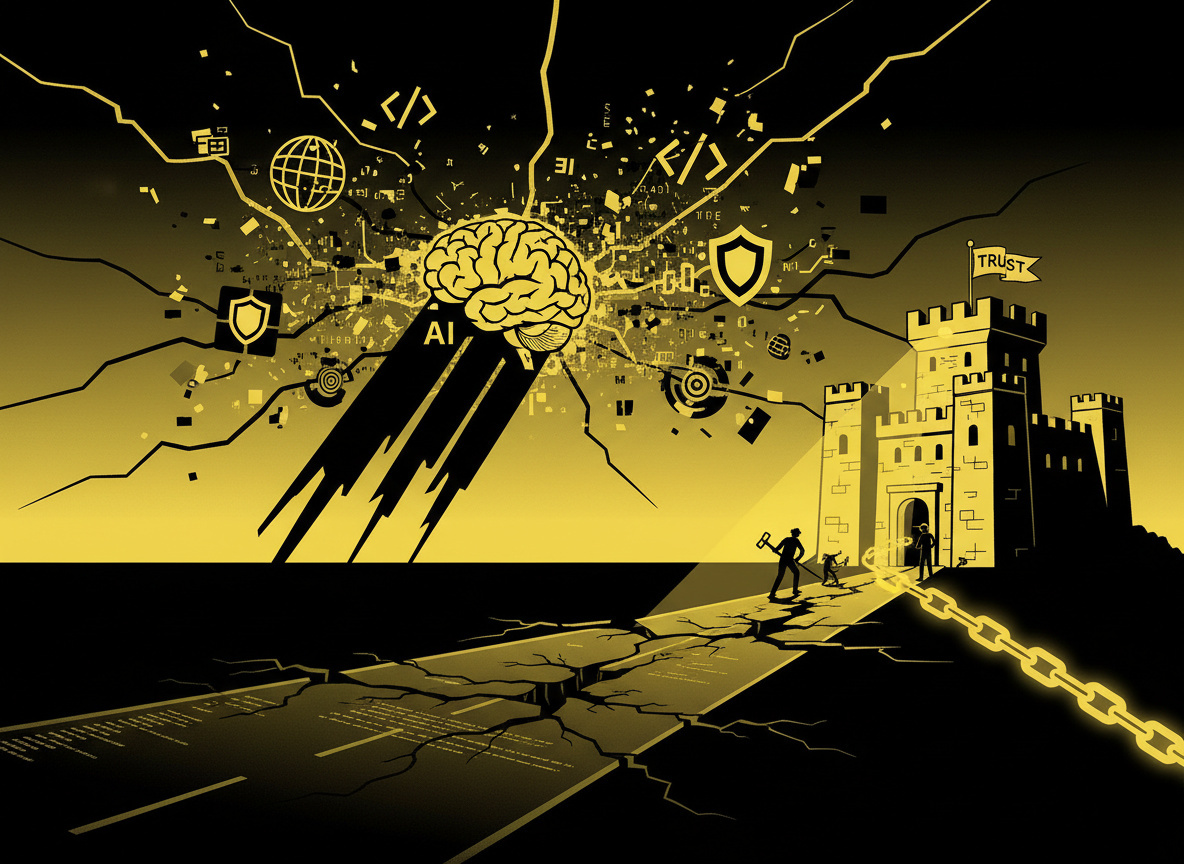
Today, those signals are being systematically devalued. Generative AI is creating a crisis of authenticity, making it harder than ever to distinguish the genuine from the synthetic. For founders, this is not just a technical challenge; it’s a fundamental shift that redefines what it means to build a trustworthy company.
The signal is gone
The open-source ecosystem, once a relatively reliable meritocracy, is now facing a signal-to-noise crisis. Platforms like GitHub are becoming inundated with projects that cloak their complexity and utility but lack real-world robustness.
We are seeing the emergence of vast, AI-generated repositories, forks of forks with no attribution, and projects that are superficially functional but architecturally lacking. These codebases often feature redundant implementations, inconsistent documentation, and a general lack of rigour, suggesting they were assembled rather than engineered. They are phantom projects, mirages of functionality that look impressive from a distance but fall apart the second you try to build or run them.
The problem isn’t that AI-generated work is always bad. It’s that you can no longer distinguish the genuine from the synthetic at a glance.
The democratisation of high-fidelity design tools, from component libraries to AI-powered UI generators like Lovable, Bolt and V0, has created a pervasive design monoculture. When every startup can launch with the same polished aesthetic, visual trust cues become worthless. A sophisticated scam now looks identical to a well-funded company, as the polished landing page, once a reliable indicator of investment and seriousness, has become a commodity.
This affects every layer of your decision-making. Evaluating vendors, vetting acquisition targets, choosing open-source dependencies, hiring based on portfolio work - all of these relied on effort-as-signal, and now that signal is noise. This forces a critical question: If the interface can no longer be trusted, what can?
Trust as the new scarcity
In this new landscape, the most valuable and scarce resource is not capital or code, but authenticity. This presents both a threat and an opportunity for positioning.
While the digital world becomes saturated with synthetic content, companies that can prove their legitimacy will command a premium.
We must move toward a system of verification and validation that proves a real, accountable organisation exists behind a domain name. For founders, the mandate is clear. They must shift the focus from merely building products to building provably authentic organisations.
This means investing in:
- Demonstrable craftsmanship: Building products and systems with a level of quality and care that is self-evident (even if built with AI);
- Radical transparency: Sharing metrics, challenges, and roadmaps publicly;
- Verifiable accountability: Real people with real histories, willing to attach their names and reputations instead of anonymous teams or AI-generated founder photos;
- Genuine community building: Fostering real relationships and conversations with users, testimonials on a landing page are worthless;
- Exceptional human-led support: Providing responsive, expert support that cannot be automated.
The next wave of successful companies won’t be the ones that are best at generating content, but the ones that are best at earning trust. This means investing in things that don’t scale easily: real expertise, real relationships, real accountability.
Companies that figure out how to prove they are trustworthy will have the ultimate competitive advantage.


Webinar: March 18
Claude for Leaders: turning AI into strategic advantage
Claude for Leaders: turning AI into strategic advantage
Free webinar - March 18
